Brewery plants with quality made in germany.
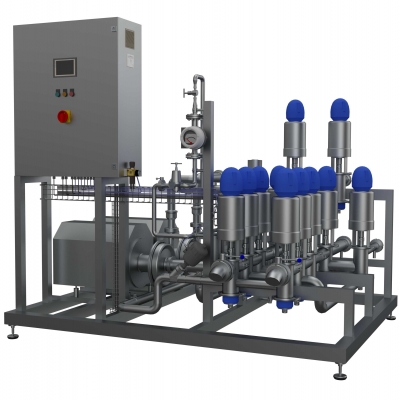
Pasteurizer Plant Image
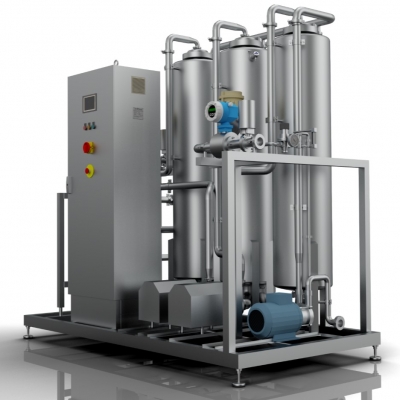
Vacuum Water Degassing, 20 ppb
 
Vacuum Water Degassing 02
 
A vacuum degassing plant for water is used when still beverages are produced, or the site does not allow the installation of a large degassing column. Our design uses the reliable operation principle of a stripping column, but with a vacuum as an additional degassing effect. The main reason for the construction of three stationary columns is that the water is exposed to the vacuum for much longer in this way than is possible with any other construction. Our vacuum degassing plants use the vacuum very thoroughly with several mechanisms of action. First of all in the column heads. Here the water is sprayed into the vacuum. A large part of the oxygen is thus already removed. Next the water trickles down and then along the packing. Here the water is exposed to the vacuum (as a thin film). A third effect is exploited in the last column. Before atomising the water a slight amount of CO2 or N2 is added. The CO2 / N2 is sucked through all three columns by the vacuum current in a counterflow configuration. The CO2 / N2 acts as a stripping gas. A reinforcement of all three degassing effects occurs (not shown in the simplified diagram) by the multiple circulation through the respective columns. If desired, a part of the added CO2 gas can be added to the finished degassed water (also not shown in the diagram). The water will be buffered with CO2. The tendency to re-contamination with oxygen is thus reduced.

Sizes:
Type 32 max. 6 m³/h (60 hl/h)
Type 50 max. 12 m³/h (120 hl/h)
Type 65 max. 23 m³/h (230 hl/h)
Type 80 max. 35 m³/h (350 hl/h)

Meaningful (economically) achievable residual oxygen in the degassed water: <0.02 mg (ppm) O2 / litre or <20 µg (ppb) O2 / litre
The value for the residual oxygen depends on the oxygen content and the temperature of the raw water. The cooling of the water should therefore always take place after the water degassing.

Vacuum Water Degassing, 80 ppb
 
vacuum water degassing 80ppb 01
In water for soft drinks, a higher residual oxygen content is accepted (compared to water in beer production). The required residual oxygen of 0.08 ppm (0.8 ppm in fresh water at a water temperature of approximately 20 ° C) can be achieved with only one vacuum column. This is a 10-fold reduction of the oxygen. This degassing module is integrated into our beverage mixing plants (in-line mixer). The height of the column and the column diameter is determined individually for each application case.

Sizes:
Type 32 max. 6 m³/h (60 hl/h)
Type 50 max. 12 m³/h (120 hl/h)
Type 65 max. 23 m³/h (230 hl/h)
Type 80 max. 35 m³/h (350 hl/h)

Meaningful (economically) achievable residual oxygen in the degassed water: <0.08 mg (ppm) O2 / litre or <80 µg (ppb) O2 / litre
The value for the residual oxygen depends on the oxygen content and the temperature of the raw water. The cooling of the water should therefore always take place after the water degassing.

Pasteurizer Plant Image
In the stripping process a gas is guided over a thin film of the water to be degassed in a countercurrent configuration. The stripping gas removes the dissolved oxygen from the water (desorption) and guides it into the gaseous phase. The pressure inside the column corresponds to that in the surrounding atmosphere outside the column. The gas is dissipated into the atmosphere (via the roof). The great advantage of this process is its simplicity. There are very few components. This ensures a high level of system availability. The plants are incredibly quiet as no vacuum pump is required. CO2 or N2 (nitrogen) can be used as a stripping gas. Nitrogen is more effective in removing the oxygen and it is not absorbed by the degassed water in the same way as the CO2. Nitrogen is therefore a good choice for the manufacture of still beverages. CO2 is the stripping gas of choice for the manufacture of carbonated beverages. The degassed water is buffered with CO2. The tendency to recontamination with oxygen is thereby reduced. The CO2 used is added to the product in large quantities. The effective additional consumption of CO2 is very low compared with a vacuum degassing plant. A vacuum degassing plant also uses CO2 gas to improve the degassing effect. The CO2 gas fed in a vacuum gas plant can however not remain in the water due to the vacuum.

We offer both the processes described below:

- Hot degassing (hot column)
- Cold degassing (cold column)

Attainable residual oxygen in the degassed water with both processes: < 0.02mg(ppm) O2/litre or < 20µg(ppb) O2/litre
The value for the residual oxygen is dependent on the oxygen content and the temperature of the raw water. The cooling of the water should therefore always take place after the water degassing. The column diameter and the column height are determined on the basis of the water temperature, oxygen content in the raw water, the desired throughput rate and the permitted residual oxygen.

Hot degassing - "hot column"
 
water degassing cot column gas stripping
 
Hot degassing offers the benefit of additional pasteurisation. Hot degassing is the ideal choice if problems with water hygiene are anticipated (e.g. in the mains water). Little energy is required for operating the plant due to the high level of heat recovery. The water enters the plant cold and leaves it cold as well. The increase in temperature due to pasteurisation is only approx. 8°C even if no cooling zone is provided in the heat exchanger (available as an option). In principle no CIP cleaning or sterilisation is required due to the hot operation and the internal sterilisation steps on start-up. Acidic cleaning should only be carried out occasionally depending on the hardness of the water. The additional price compared with the "cold column" is not too extreme as a smaller column is adequate for the same output.

Gas requirement: approx. 0.10 kg/hl water, approx. 5% of this is lost (via the roof, rest remains in the water)

Size: Throughput: Steam
requirement*:
Type 32 max. 6 m³/h (60 hl/h) 76 kg/h
Type 50 max. 12 m³/h (120 hl/h) 151 kg/h
Type 65 max. 23 m³/h (230 hl/h) 288 kg/h
Type 80 max. 35 m³/h (350 hl/h) 439 kg/h
Type 100 max. 55 m³/h (550 hl/h) 689 kg/h
Type 125  max. 86 m³/h (860 hl/h) 1078 kg/h

*=saturated steam, insulated column, water inlet temperature 15°C, heating temperature 72°C

Additional equipment:
- Insulation of the column
- Downstream carbonation (in addition to pre-carbonation through the degassing process)
- Cooling

Cold degassing - "cold column"
 
water degassing cold column gas stripping 01
 
The degassing process takes place completely at the temperature of the incoming water. This process always has the lowest energy consumption with the same output even though the column is the highest. The plant is extremely robust and there are hardly any wearing parts. The plant can be manufactured economically for many different sizes. Even for very small outputs.

Downstream UV sterilisation must be integrated if there are problems with the hygiene of the raw water. If severe problems with water hygiene are anticipated, then preference should be given to pasteurisation ("hot column", see above).
Gas requirement:  approx. 0.22 kg/hl water, amount lost:  approx. 5% (rest remains in the water)

water degassing cold column gas stripping 02

Sizes:
Type 15 max. 1.2 m³/h (12 hl/h)    0.02 ppm
Type 25 max. 3 m³/h (30 hl/h) 0.02 ppm
Type 32 max. 4.5 m³/h (45 hl/h) 0.05 ppm
Type 50 max. 12 m³/h (120 hl/h) 0.05 ppm (optional 0.02 ppm)
Type 65 max. 23 m³/h (230 hl/h) 0.05 ppm (optional 0.02 ppm)
Type 80 max. 35 m³/h (350 hl/h) 0.05 ppm (optional 0.02 ppm)
Type 100 max. 55 m³/h (550 hl/h) 0.05 ppm (optional 0.02 ppm)
Type 125  max. 86 m³/h (860 hl/h) 0.05 ppm


Additional equipment:
- Downstream carbonation
- Cooling
- UV sterilisation

Modules

Grid view
List view

Components

Grid view
List view

Services

Grid view
List view
  • Engineering

    Engineering

    Special situations might arise when just the delivery of an autarkic production module is not enough, i.e. it becomes necessary to also have the environment adapted to the new situation. The scope of our…

  • Support & Supply

    Support & Supply

    Our company supplies production equipment as well as raw materials and additives for the food and beverage industry all over the world. Our Export Manager Mrs. Meyer has built up great expertise over 25…

Brauereimodule-Bild21.pnglogo--big2.pngBrauereimodule-Bild2.pngBrauereimodule-Bild20.pngMuntons.pngBrauereimodule-Bild13.pngBrauereimodule-Bild19.pngBrauereimodule-Bild18.pngBrauereimodule-Bild6.pngBrauereimodule-Bild11.png200x80px-150dpi_Brewtech.pngBrauereimodule-Bild1.pngBrauereimodule-Bild8.pngBrauereimodule-Bild16.pngMkgaa1920x1080.pngBrauereimodule-Bild7.pngBrauereimodule-Bild14.pngBrauereimodule-Bild10.pngBrauereimodule-Bild15.pngBrauereimodule-Bild12.pngBrauereimodule-Bild17.png

We use cookies on our website. Some of them are essential for the operation of the site, while others help us to improve this site and the user experience (tracking cookies). You can decide for yourself whether you want to allow cookies or not. Please note that if you reject them, you may not be able to use all the functionalities of the site.